An old dealership full of orphan cars
The building itself is part of the argument. The Ypsilanti Automotive Heritage Museum occupies a former Hudson dealership on North Huron Street — a low, wide commercial structure that has the proportions of a place built to show off cars. Walk in and the floor still feels like a showroom floor. The overhead light falls on hood lines and chrome the way it was always meant to.
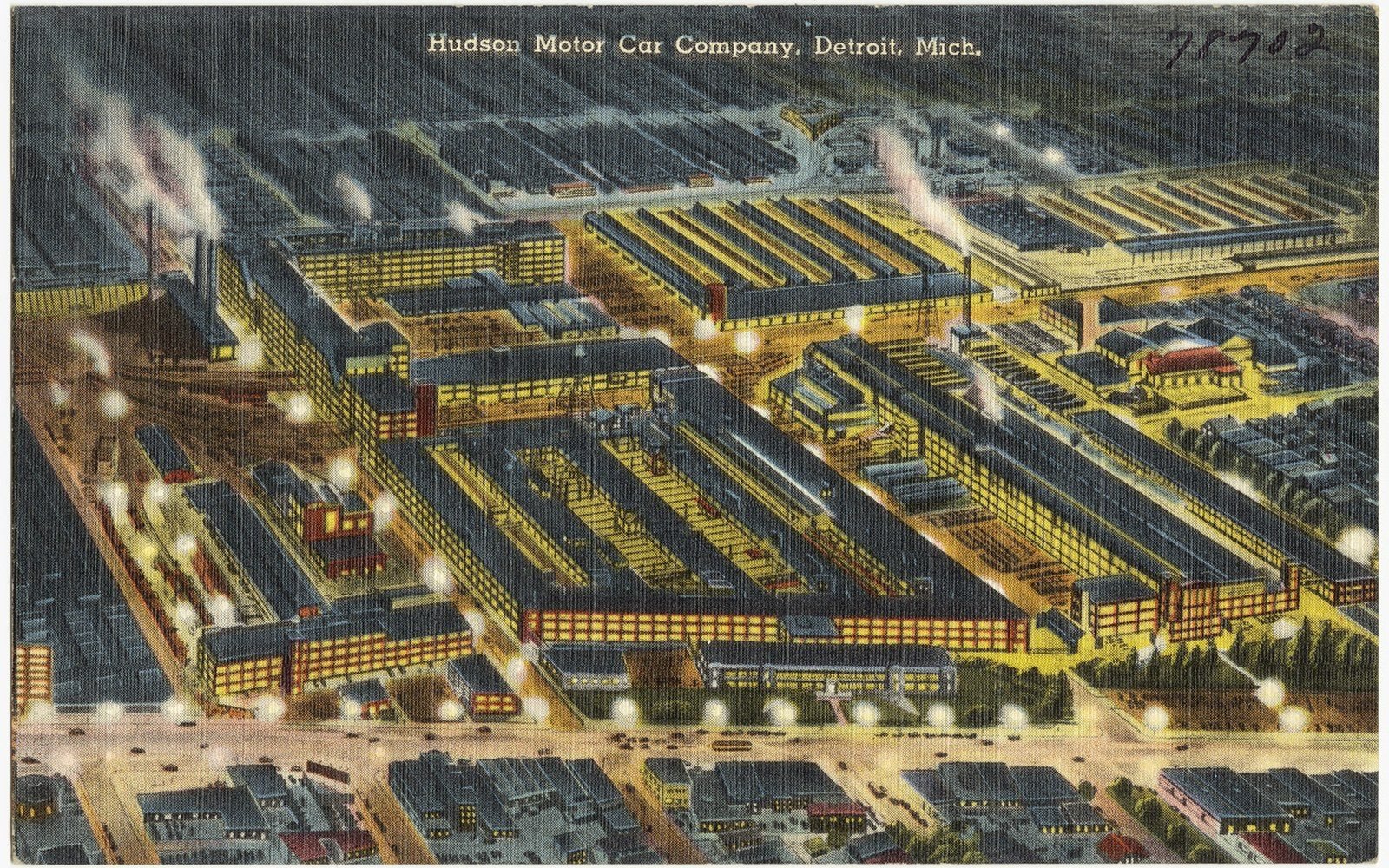
Hudson is the reason the building exists in this role, and Hudson is the reason Ypsilanti has a claim to automotive history that goes well past civic boosterism. The company was founded in 1909 — named not for the river but for the Detroit department-store magnate Joseph L. Hudson, who provided early backing — and for decades it was a genuine force in American motoring. The cars were fast, well-engineered, and built by workers who lived in towns like this one. The Step-Down design introduced in 1948, in which the floor dropped inside the frame rail to lower the center of gravity, was a serious piece of engineering, not a stylist's trick. Hudson won NASCAR races with it. Then the company merged with Nash in 1954 to form American Motors, and the name quietly disappeared.
That arc — ambition, achievement, absorption, erasure — is the museum's central subject. The cars it holds are, in the trade's unsentimental vocabulary, orphans: makes whose parent companies no longer exist, marques that ceased production and left their owners with vehicles nobody was manufacturing parts for. Hudson is the biggest name here, but the collection reaches wider. Kaiser-Frazer, the postwar venture launched in the old Willow Run bomber plant just east of the city, is represented — a company that built nearly 750,000 vehicles in six years before the economics of competing with Ford, General Motors and Chrysler proved impossible. Tucker is here too, or at least the Tucker story is, which is almost always how it goes: Preston Tucker built fifty-one of his radical 1948 sedans before federal investigations (contested in their motives ever since) effectively ended the company.
What the museum does well is keep the engineering legible. These are not trophy restorations behind rope lines; they are cars you can get close to, read the plaques on, and understand as objects that solved specific problems in specific ways. The Step-Down Hudson's chassis arrangement is easier to grasp when you're standing next to a cutaway or a well-annotated example than it ever is in print. Kaiser-Frazer's bet on a front-wheel-drive prototype that never reached production — the Henry J was the economy-car compromise that made it to dealers instead — is the kind of industrial near-miss that the museum holds without editorializing. The facts are strange enough on their own.
The dealership building contributes something the cars cannot supply by themselves: continuity of place. This is not a collection that migrated into a repurposed warehouse or a county fairground pavilion. The Hudson dealership in a Hudson town retains a logic that makes even a visitor who knows nothing of the marque feel the weight of the connection. North Huron Street sits within easy walking distance of Depot Town and the Cross Street Bridge — the corridor where Ypsilanti's commercial and industrial history has the most physical presence — and the museum fits that corridor rather than standing apart from it.
There is, as with any collection of orphan cars, a slight melancholy in the room. These are machines from companies that lost. Some lost to consolidation, some to undercapitalization, some to bad timing, some to forces that automotive historians still argue over. The Hudson that won on the NASCAR circuit in the early 1950s could not outrun the balance sheet. But melancholy and interest are not incompatible, and the museum earns its place precisely because it refuses to let the losing side of the American auto industry disappear into the general triumphalism of the postwar boom story. Ypsilanti built cars nobody remembers, and this building is where you come to remember them.
Keep reading