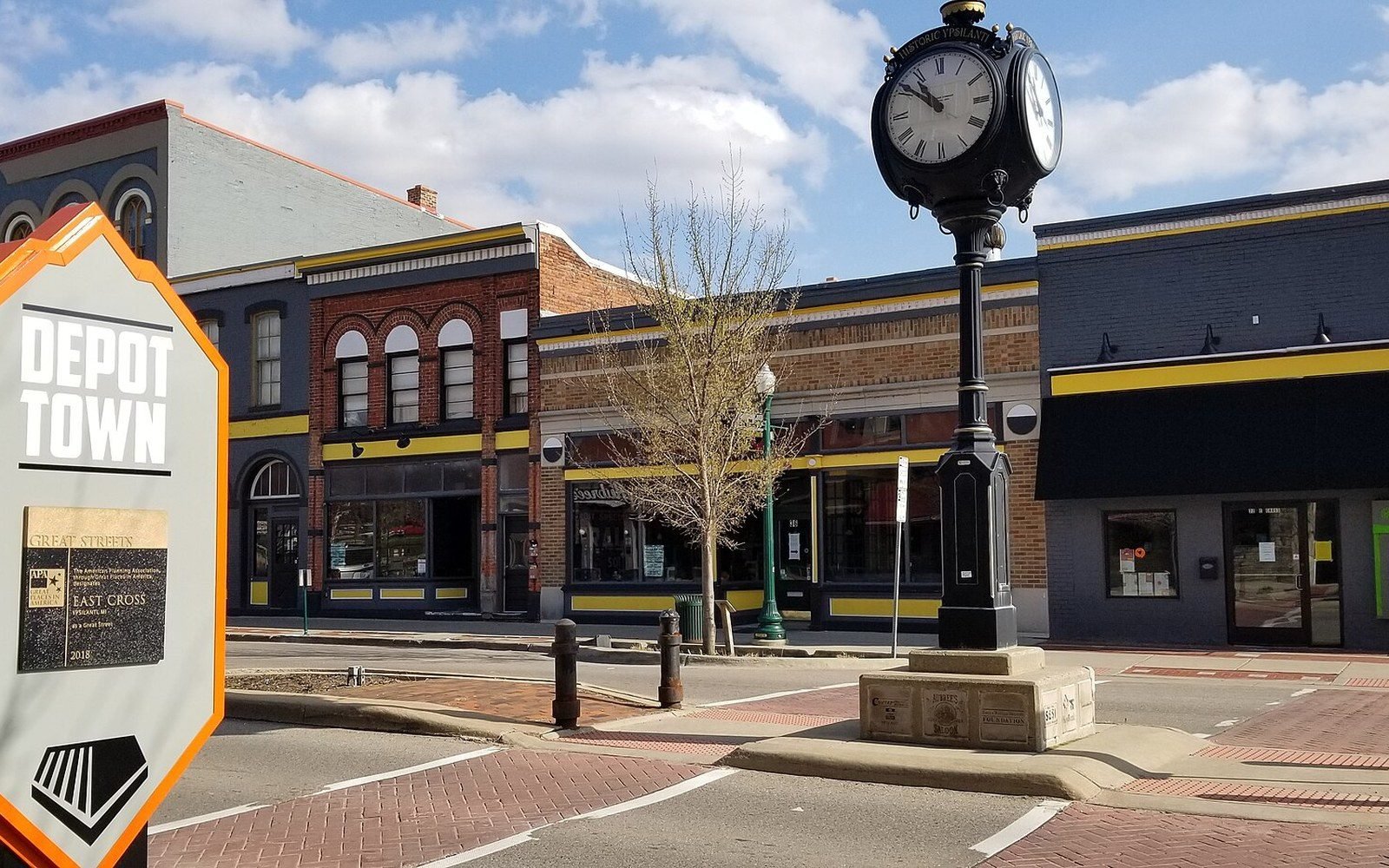
Depot Town's oldest commercial survivor, and what a Civil War-era barracks block looks like after a century and a half of continuous use
What It Is and Where It Stands
Depot Town clusters its best architecture around East Cross Street and the freight district that grew up beside the old Michigan Central rail corridor. Within that cluster, the Thompson Block is the heavyweight — a substantial Italianate commercial building that dates to the Civil War period and has been earning its keep ever since. It stands on the north side of East Cross Street, brick and blunt and considerably older than it looks on a fast pass, its ground floor long since reworked but its upper cornice and window surrounds still carrying the grammar of the 1860s.
That grammar is worth pausing over. The building works in the Italianate idiom that dominated American commercial architecture in the decades just before and after the Civil War — a style that arrived via pattern books and traveled fast through the Midwest because it was brick-friendly, dignified without being expensive, and easy for local builders to execute. Bracketed cornices, segmental arches over the windows, the suggestion of an Italian palazzo flattened and domesticated for a Michigan river town: it reads as solid civic ambition, which is exactly what it was.
The Barracks Connection
What distinguishes the Thompson Block from other surviving Italianate fronts in southeast Michigan is its wartime biography. During the Civil War, the building served as a military barracks — a staging and housing function that says something useful about Ypsilanti's position in the 1860s. The city sat on the Michigan Central line, which made it a natural transit point for men and materiel moving east toward Detroit and the larger mobilization machinery beyond. A substantial brick building close to the rail corridor was a practical asset, and the Thompson Block was pressed into that use accordingly.
It is worth holding that detail lightly. The building was not built as a barracks; it was adapted to one. The structure already existed, which is itself evidence of how quickly Ypsilanti's commercial core had developed in the antebellum decades. By the time the war created demand for temporary institutional space, Depot Town could supply it. The barracks function was a chapter, not the building's identity — after Appomattox it returned to commercial life, and commercial life is what has sustained it since.
Reading the Facade
Approach from Cross Street and read the upper floors. The brickwork is load-bearing in the old sense — walls thick enough to carry the floors above without a steel skeleton, laid in a bond that has had generations to settle into permanence. Look at the window openings: the arches are segmental, struck from a shallow arc rather than a full semicircle, which is characteristic of the period and the style. Above the top floor, corbelling — stepped courses of brick projecting outward — builds up toward the cornice line in the manner that distinguishes an Italianate commercial block from plainer utilitarian construction. The cornice itself anchors the building visually, giving the facade a top edge and a shadow line that you lose in buildings that have been stripped or resurfaced.
The ground floor is a different story, as it almost always is in buildings of this age and type. Street-level facades take punishment: they get widened for display windows, reframed for new tenants, clad in whatever was fashionable in 1955 or 1978. The Thompson Block has not escaped that cycle. But the upper stories — the parts nobody renovates because nobody pays to renovate them — are where the building's age is still legible, and they repay attention.
What Survives and Why It Matters
Ypsilanti's Depot Town district survives as a coherent artifact partly because the freight economy that built it contracted slowly enough for the buildings to simply remain rather than be cleared for something new. The Thompson Block is the oldest and most substantial piece of that survival. It predates the interurban era, predates the automotive economy that eventually replaced rail as the city's organizing principle, and predates most of the other brick that now surrounds it on Cross Street.
That longevity is not accidental. Masonry buildings of this scale tend to outlast the economies that built them because demolition is expensive and the structure keeps offering itself as usable space. The Thompson Block has housed merchants, and then other merchants, and then other uses again — the specific tenancies change; the walls do not. What you are looking at when you look at it now is a building that has been continuously occupied and continuously adapted for roughly a century and a half, which is a kind of success that has nothing to do with preservation grants or landmark designations and everything to do with the basic utility of well-laid brick.
The joke about Ypsilanti's famous water tower tends to get more out-of-town attention than anything in Depot Town, which is the city's perennial injustice to itself. The Thompson Block is older than the tower, more central to the story of how the city actually functioned, and arguably more interesting to anyone who wants to understand what an antebellum Michigan river town looked like when it was trying to make something of itself. It is still there. It still works. That is the whole point.
Keep reading