The county west of Detroit made automobiles that lost, and the losing matters as much as the winning
A Region That Bet on the Underdog
Detroit got the headline. But Washtenaw County — and the corridor running east along Michigan Avenue through Ypsilanti toward the old Willow Run complex — built some of the most technically ambitious and commercially ill-fated automobiles in American history. Hudson, Kaiser-Frazer, Tucker, the Chevrolet Corvair: each name carries a specific kind of failure, and each failure says something precise about what American manufacturing was and what it was trying to become in the two decades after the Second World War.
None of these marques survive. That is partly the point. The cars the industry remembers are the ones that won market share decade after decade. The cars built in and around Ypsilanti were, almost without exception, the ones that got the engineering right and the business wrong, or arrived at the wrong moment, or were squeezed out by companies large enough to absorb the costs of a long fight. The Ypsilanti area was, in a useful sense, where American automotive ambition came to be tested against market reality — and where it frequently broke.
How it came to be this way
- 1945Kaiser and Frazer take over Willow Run bomber plant
- 1947Kaiser-Frazer production launches
- 1948Tucker automobile revealed; Tucker indicted for securities fraud
- 1950Tucker acquitted; company already dissolved
- 1951–1954Hudson Hornet dominates NASCAR
- 1954Hudson merges with Nash-Kelvinator to form AMC
- 1957last true Hudsons produced
- 1960Corvair introduced
- 1965Unsafe at Any Speed published
- 1969Corvair discontinued
Hudson: The Flathead That Could Have Won
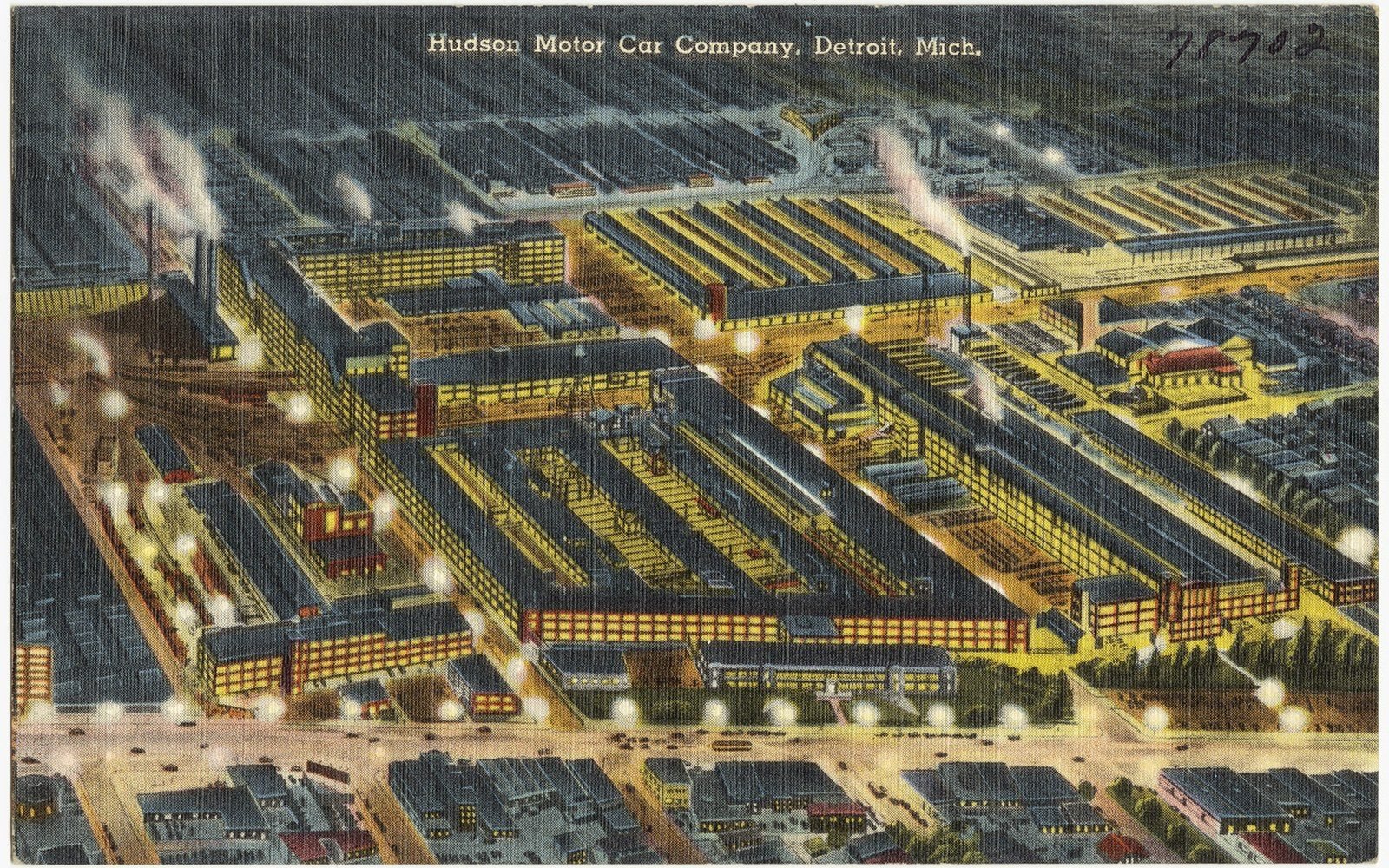
Hudson Motor Car Company was a Detroit firm, but its story ended here. By the early 1950s, Hudson had perfected the step-down body — a low-slung unibody design in which the passenger floor sat inside, rather than on top of, the frame rails. The result was a center of gravity so low that Hudson's straight-six-powered Hornets dominated NASCAR racing between 1951 and 1954, winning the championship three years running. The car drove better than almost anything else on American roads at the price point. It also sold in declining numbers every year.
The problem was capital. Hudson lacked the stamping capacity and the cash reserves to restyle its body quickly enough to keep pace with the annual model changes that General Motors had made the industry standard. By 1954, the company merged with Nash-Kelvinator to form American Motors Corporation, and Hudson production moved to the Nash plant in Kenosha, Wisconsin. The last true Hudsons were built in 1954 — after that, the Hudson-badged cars of 1955–1957 were Nash-based. The step-down was gone.
What Ypsilanti holds of this story is partly symbolic, partly industrial. The Ypsilanti area was Hudson territory in the sense that Hudson's supplier network, its dealers, and the workers who built it were embedded in the same southeastern Michigan labor market that the postwar automotive boom had created. When Hudson fell, the ripple ran through the whole district.
Kaiser-Frazer launched in 1947 and for a year or two outsold expectations.
Kaiser-Frazer and Willow Run: The Bomber Plant That Couldn't Sell Sedans
The Kaiser-Frazer story is Ypsilanti's most visible piece of this history, because the plant is the most visible thing in it. The Willow Run bomber plant — designed and built at extraordinary speed by Ford during the Second World War, nearly a mile of factory floor under one roof — was taken over by Henry Kaiser and Joseph Frazer in 1945. Their logic was sound on its face: here was the largest enclosed manufacturing space in the world, a trained industrial workforce, and a postwar American public that was hungry for new cars after years of wartime production freezes.
Kaiser-Frazer launched in 1947 and for a year or two outsold expectations. The cars were well-proportioned by the standards of the day, and Kaiser's later models showed genuine design flair. The company's designer, Howard Darrin, gave the 1951 Kaiser a wraparound windshield and a silhouette that predated what the Big Three would introduce several years later. But Kaiser-Frazer had no V-8 engine at a moment when American buyers were beginning to demand one, and the cost of developing one from scratch would have required investment the company couldn't sustain. By 1953, Kaiser-Frazer had pulled back almost entirely to producing Willys vehicles in Ohio. Willow Run fell quiet. The car that might have been the most progressive American family sedan of the early 1950s had run out of road.
Tucker: 51 Cars and a Federal Trial
Preston Tucker built his car in Chicago, not Ypsilanti, but Tucker belongs in any account of this era's automotive ambitions — and the southeastern Michigan industrial ecosystem was the world Tucker operated in, the one that supplied him, employed engineers who understood him, and watched his collapse with a professional interest that had nothing to do with schadenfreude.
Tucker's 1948 automobile was, by the engineering standards of its moment, startling: a rear-mounted flat-six, a central headlight that turned with the steering, a padded dashboard and a windshield designed to pop out in a crash. Forty-seven of the 51 cars Tucker built still exist, which is a testament to how well the thing was made and how small the production run was. Tucker was indicted for securities fraud in 1949; he was acquitted in 1950, but the company was already dead. Whether the prosecution was driven by legitimate legal concern or by competitors and politicians who found the idea of a successful independent automaker inconvenient remains, depending on who you read, either an open question or a settled one.
What Tucker shares with Kaiser-Frazer and Hudson is the structure of the problem: a technically credible car, a company that couldn't build the distribution and capital base fast enough, and an industry environment in which the Big Three's cost advantages compounded relentlessly.
The Corvair: The Car That Got Legislated
The Chevrolet Corvair is the most complex case in this group, because it was made by General Motors — the largest automaker in the world — and it still failed. Introduced in 1960 as GM's answer to the imported compact, the Corvair used an air-cooled rear-mounted flat-six, an unusual and in many ways sophisticated choice for a mass-market American car. It handled differently from front-engine, water-cooled cars, and early suspension tuning made it challenging at the limit for drivers who had learned in conventional vehicles.
The Corvair's particular history in this region is one of assembly, suppliers, and the industrial geography of southeastern Michigan. What ended it nationally was Ralph Nader's 1965 book Unsafe at Any Speed, which made the Corvair its central example. GM's response — which included surveillance of Nader, a fact that emerged publicly and damaged the company's credibility badly — became a landmark in the history of American consumer advocacy. Sales collapsed. The Corvair was discontinued in 1969, though by then its suspension design had been significantly revised and the engineering critique had largely been answered.
The Corvair is the outlier in this company: it didn't fail because it was undercapitalized or because its maker lacked scale. It failed because it arrived as a culture was beginning to ask different questions about what manufacturers owed the people who bought their products.
What the Losing Looks Like Now
The Ypsilanti Automotive Heritage Museum holds artifacts from several of these stories — the orphan marques, the cars that ran out of road before they ran out of ideas. Willow Run, after decades of postwar industrial use, has been partially preserved. The broader footprint of this history is harder to see: it lives in the supplier network, in the labor geography of the county, in the names on union contracts and bankruptcy filings that nobody reads anymore.
The cars nobody remembers were not, for the most part, bad cars. Some were better than the ones that survived them. The lesson Ypsilanti and its surrounding corridor offers is not about failure as a character flaw but about the industrial conditions that make success possible: access to capital, scale, distribution, and enough time to iterate. Most of the cars in this story had one or two of those things. Very few had all four.
Keep reading