The hinge that holds two halves of the city together
The Cross Street Bridge doesn't announce itself. It carries you over the Huron at one of the river's narrowest urban crossings, and most people who use it are thinking about parking, not about the fact that they are standing on the seam of the city. But pause mid-span and the whole of Ypsilanti's layered geography snaps into focus: Depot Town's brick warehouses massed on the east bank, the water tower rising above the ridge to the west, and the river doing what rivers do in post-industrial cities — holding the two halves just far enough apart to make the difference legible.
That difference is real, not merely scenic. The east bank was the working city: rail freight, cold storage, feed and hardware, the commerce that came with the Michigan Central depot and the network of sidings behind it. The west bank was the civic and residential city — the older grid, the institutional buildings creeping up toward what would become Eastern Michigan University's campus on the hill, the houses behind Michigan Avenue pressing up against Forest Avenue. The river was the boundary between those two economies, and Cross Street was, for a long time, the point where they transacted with each other.
Reading the bridge from the middle
The current bridge is functional rather than elegant, but its sightlines are generous. Look east and the Depot Town block-fronts fill the near view — long brick facades, corbelled cornices, the occasional segmental arch over a loading door that no longer loads anything. Look west and the ridge lifts the skyline to a point: the water tower's limestone shaft, its round tank, and, if you know the city's standing joke, you already know the joke — there is one, it is old, and it is done by the time you finish this sentence. Above and behind the tower, trees cover the upper streets, hiding everything domestic.
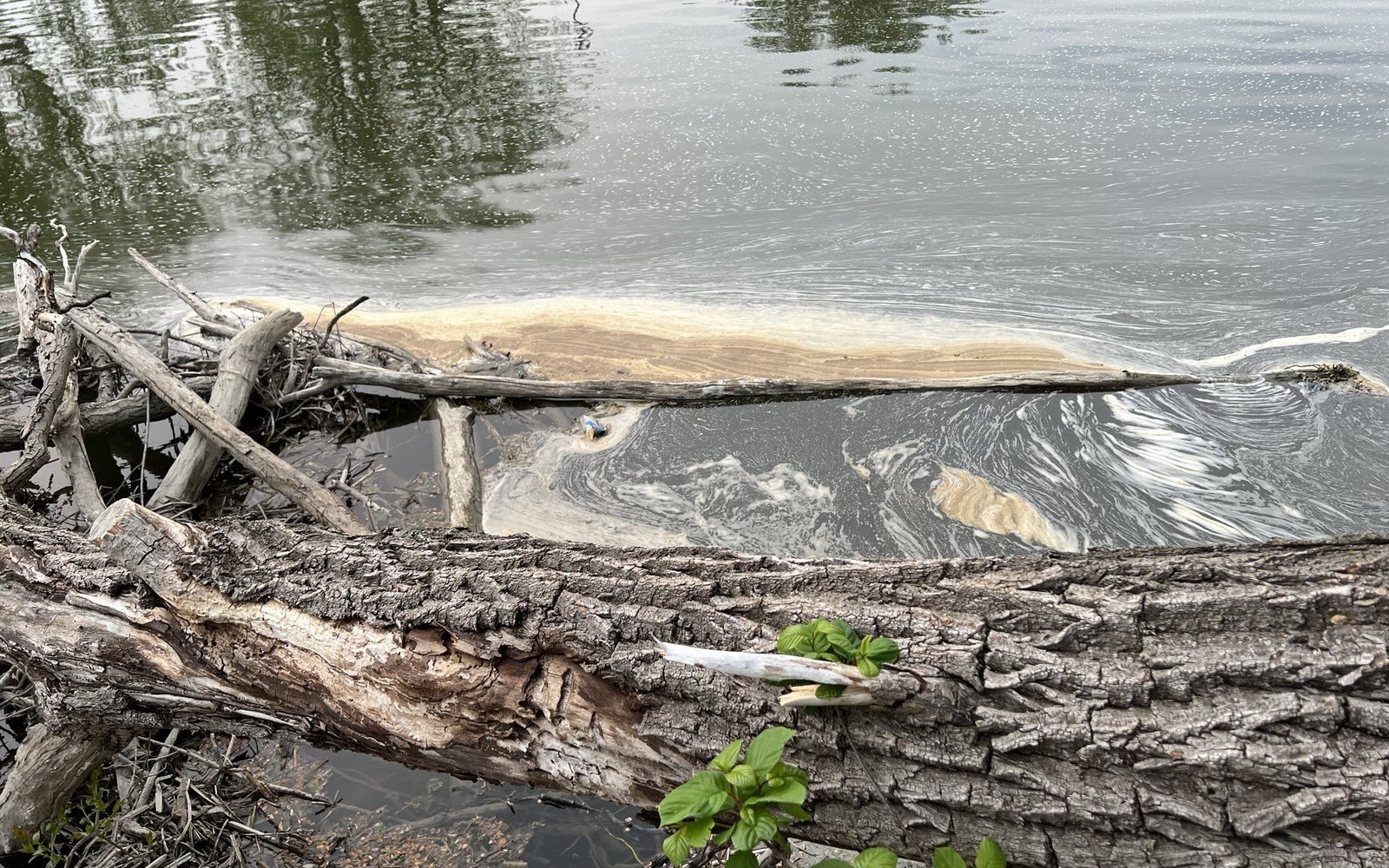
The river itself is worth looking at rather than through. The Huron here is quick and shallow-looking after rain, slow and green in summer; it carries the texture of a working river that has been cleaned up without quite being tamed. Frog Island begins just downstream to the south, the floodplain meadow that the city keeps because the city has no practical choice — the Huron takes it back too regularly to build on. Upstream to the north, the river bends away toward the old paper-mill reach and the quieter crossing at Forest Avenue.
What the bridge has always done
Cross Street as a thoroughfare was never quite the main event — that was always Michigan Avenue, the old Chicago Road running a few blocks north. But Cross Street connected the residential streets of the west side to the working blocks of Depot Town directly, without the length and noise of Michigan Avenue's commercial strip. Tradespeople, labourers, anyone with business at the warehouses or the depot would have used this crossing as a shortcut. The interurban — the electric railway that linked Ypsilanti to Ann Arbor and Detroit before the car swallowed those routes — moved along the main corridors, but the foot and wagon traffic bled down to Cross Street because the geometry was direct.
That directness still works. Today the bridge is as much a pedestrian crossing as a car route, particularly for the park-goers moving between Riverside Park on the west bank and the Depot Town restaurants and bars on the east. It is a utilitarian bridge, but it holds a larger importance: it is the shortest route between two parts of the city that still feel genuinely distinct, and the river visible from it is the reason they stayed that way.
The seam, not the landmark
Every small city has a hinge point — a crossing or an intersection that doesn't draw attention to itself but around which the whole spatial logic pivots. For Ypsilanti, the Cross Street Bridge is that hinge. The landmarks are elsewhere: the water tower on its ridge, the Thompson Block anchoring the Depot Town corner, the big blocks of freight architecture facing the river. The bridge is what connects the looking-at to the being-in, the viewing platform to the place being viewed. Stand on it long enough, watching the river run below the brick and below the tower, and the city's whole industrial and civic biography is visible in the gap between the two banks — still divided, still transacting, still hinging on this one quiet crossing.
Keep reading