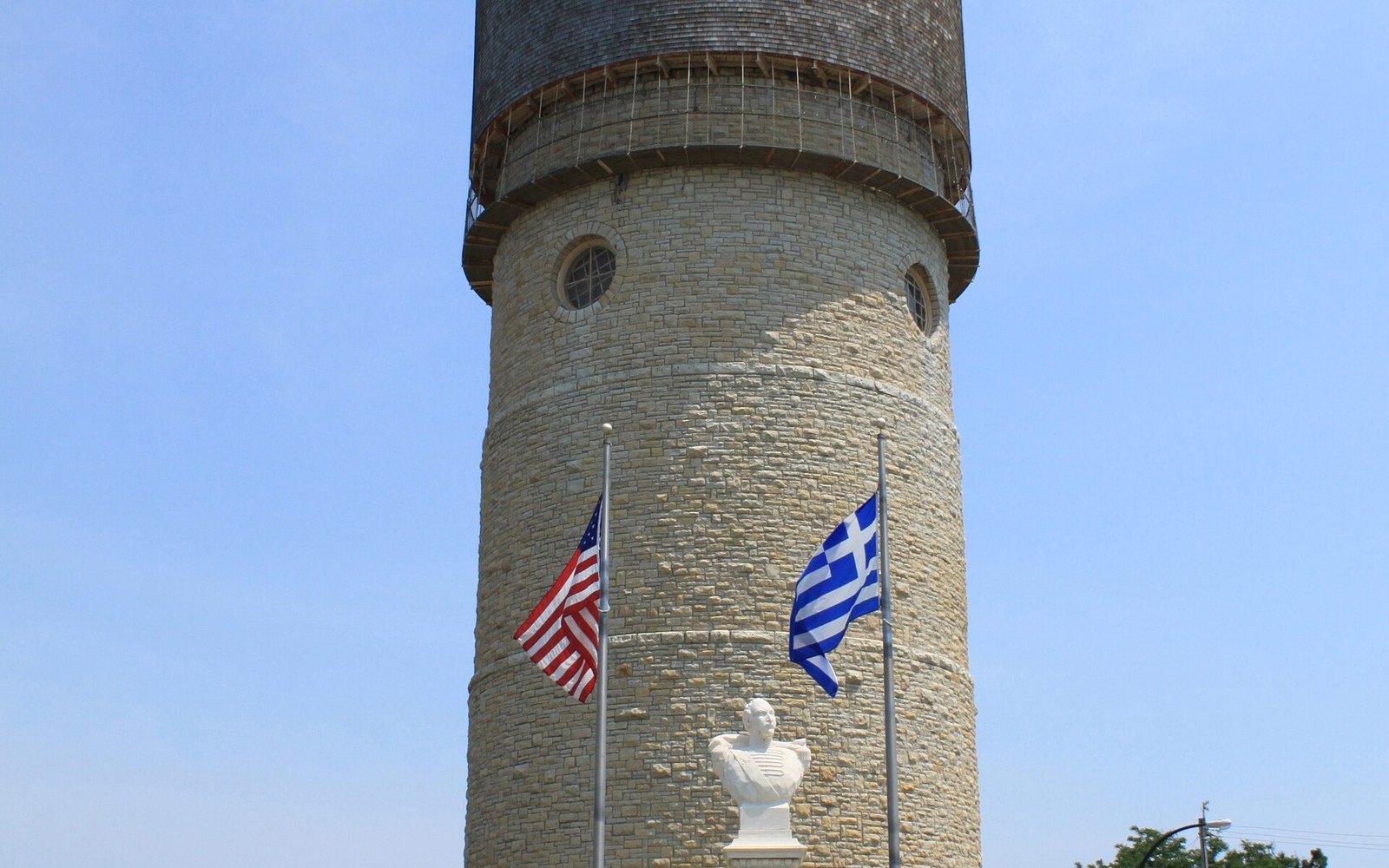
Ypsilanti's most recognisable structure wasn't built to be admired — it was built to hold water under pressure, and the engineering came first
A Machine Wearing a Coat
There is a joke about the Ypsilanti Water Tower's silhouette. The city has been making it for generations, it is one line, and you will hear it before your first week is out. Having acknowledged it, this article will say nothing more on the subject — because the tower's actual shape, the real engineering reason for that particular profile, turns out to be considerably more interesting than anything the joke implies.
The tower stands on a low rise at the north end of the old city grid, visible from the Cross Street Bridge and from most of the higher ground along the Huron valley. It is built of Joliet limestone — a pale, cream-coloured sedimentary stone quarried in Illinois, the same material that gave Chicago its early civic buildings their cool, authoritative face. In Ypsilanti it reads as something between ivory and warm grey, depending on the season and the hour, and it is simply unlike anything else in a city built primarily of brick. The contrast is not accidental. The water tower was always understood to be a public monument as much as a public utility, and whoever specified the cladding material was reaching for permanence and civic seriousness rather than cost efficiency.
But underneath the limestone, the tower is a piece of hydraulic infrastructure with a particular and precise function, and the function dictates the form almost entirely. To understand the tower, you have to understand what a standpipe is.
How it came to be this way
- 1890stower built as part of Ypsilanti municipal waterworks expansion
- Late 19th c.era of industrial Midwest municipal infrastructure investment (waterworks, sewerage, electrical)
- 20th c. (later)tower decommissioned from active water service; preserved as landmark
Pressure, Height, and the Purpose of the Tube
A standpipe is, at its most basic, a vertical column of water. The water is raised mechanically — by pump — to a height sufficient to generate the pressure needed to push it through a distribution system and, crucially, up through the hoses of a fire engine at a scene. Every metre of elevation above the delivery point represents a measurable increment of pressure at the tap or the hydrant. The whole system is governed by gravity: raise the water high enough, and the physics does the rest.
This is not the same principle as a conventional water tower, though the two are often confused. A conventional tank tower holds a large reserve of water in a wide, bulbous tank perched on a supporting structure — the round-bellied forms on stilts that punctuate the American agricultural Midwest. The tank provides volume as much as pressure: the idea is to store enough water to buffer demand surges across a distribution network. The tank can be relatively squat and wide because its job is storage.
A standpipe's job is different. The critical dimension is height, not volume. The tube needs to be tall enough to generate the required working pressure at the base — in Ypsilanti's case, sufficient to serve the growing city and fight a serious fire in a commercial brick building. And the tube, naturally, is a tube: a cylinder, narrow in proportion to its height, because the column of water is the mechanism, not the reservoir. The tower you see from Michigan Avenue is almost exactly what a standpipe has to be, geometrically speaking, to do what it was designed to do. The limestone and the decorative caps are civic dressing. The cylinder is not a stylistic choice.
Built in the 1890s during the period of rapid municipal infrastructure investment that accompanied the city's growth as a manufacturing and rail hub, the tower was part of Ypsilanti's effort to provide reliable waterworks for a population that was densifying around the factories and the freight yards of Depot Town. Fire was the constant practical anxiety: dense brick commercial districts burn hot and fast if the pressure fails, and insurance underwriters took a close interest in a city's water supply. The standpipe was, among other things, an argument to the insurance industry that Ypsilanti was a serious town with serious infrastructure.
The construction is Joliet limestone over a brick core, and the masonry is detailed with genuine care. At the cap and base you can see coursed stonework with carved mouldings, and the brickwork of the interior structure is competent work by the standards of its decade. The height — roughly 147 feet — is not an aesthetic gesture; it is approximately the figure required to deliver adequate working pressure to the service area the waterworks was designed to cover. Everything about the proportions follows from that number.
The Ypsilanti Water Tower is no longer an active part of the municipal water system.
Reading the Tower Against the City
Placed in the landscape of the city, the tower does something useful that its builders probably intended and that generations of residents have internalised without necessarily thinking about it: it is a navigation point. Rising well above the tree canopy on its low hill, it serves as one of those rare fixed landmarks from which you can reckon position and direction while moving through the grid. The reading-the-skyline logic of the city — which roofline is which building, which spire or stack tells you where you are — runs directly through the tower. You catch it from the river corridor, from the rail-parallel stretch of Michigan Avenue, from the higher terraces above Frog Island. It is the single most reliable fix point in a city whose skyline is otherwise agreeably modest.
This is partly a consequence of location. The tower was sited on high ground, as standpipes necessarily must be, since the practical pressure gain from elevation only works if the elevation is real and the base of the pipe sits on ground above the distribution zone. The hill it occupies places it slightly apart from the commercial density of Depot Town and the Cross Street corridor — not embedded in the city fabric the way the Thompson Block or the brick blocks along Michigan Avenue are embedded, but hovering just above it, serving the city from a position of gentle geographic dominance.
That separation gives it another quality: seen from Riverside Park or from the walking path along the Huron, it sits above the rooflines without competing with them, a pale vertical form against whatever sky the weather provides. In winter, stripped of tree cover, it reads with particular clarity across the river flats. In summer it appears and disappears between the canopy in a way that makes coming upon it unexpectedly oddly satisfying — a small recurrence of the city announcing itself.
What Survives and Why
The Ypsilanti Water Tower is no longer an active part of the municipal water system. It has been out of service in its original capacity for decades. What this means, practically, is that the structure now exists as a preserved landmark rather than working infrastructure — maintained against the logic of obsolescence by the fact that it is irreplaceable, visually, within the city it was built to serve.
The arguments for preserving industrial and infrastructural monuments are sometimes made on purely sentimental or touristic grounds, and sometimes those arguments are the weakest case you can make for a building. The case for the water tower is stronger than that. It is a genuine piece of engineering history: a working standpipe of a type that was current municipal practice in the industrial Midwest during the late nineteenth century, built at a moment when cities like Ypsilanti were for the first time constructing the hidden systems — waterworks, sewerage, electrical distribution — that made modern urban density possible. Most of those systems left no visible trace above ground. The water tower is the exception. It is the part of the nineteenth-century infrastructure project that you can actually look at.
There is also the matter of the limestone, which weathers beautifully and has not required the kind of remediation that would have threatened the structure's integrity. The material choice — expensive at the time, quarried hundreds of miles from site and barged and railed to Michigan — has paid a long dividend. The tower looks, from a reasonable distance, roughly as it looked when it was completed: pale, slightly formal, sitting on its hill with the mild authority of something built to last because the people who built it expected it to matter.
That expectation was not misplaced. The tower has outlasted the waterworks it was built to serve, the industrial economy that funded it, and most of the wooden buildings that surrounded it when it first went up. What remains is a standpipe that never stopped being useful to the city — just not for holding water anymore.
Keep reading