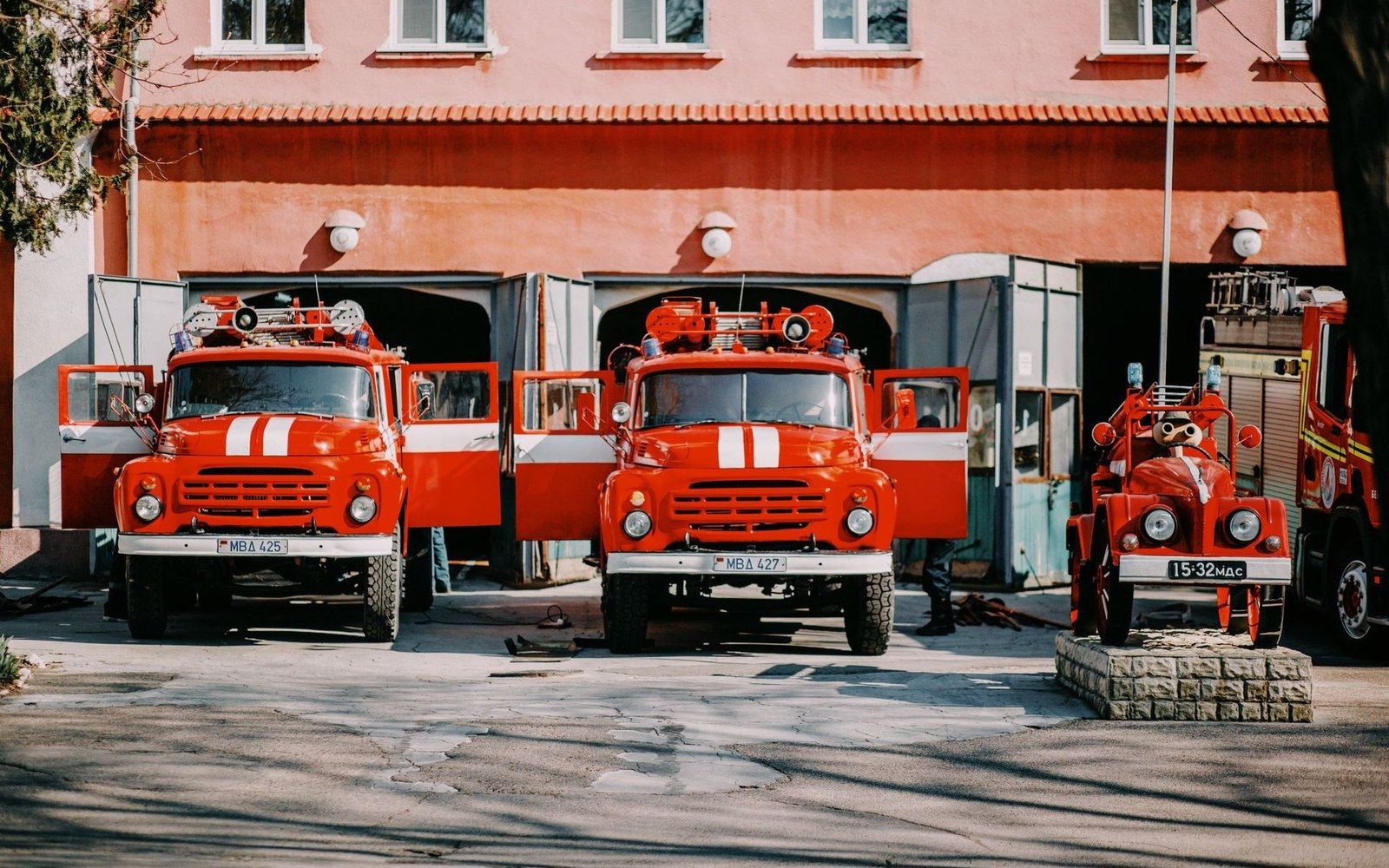
A working firehouse kept exactly as it was — and why that matters more than it sounds.
The Building Itself
There are places that stop time through curatorial effort — careful labels, climate-controlled cases, the deliberate hush of an institution. And then there are places that stopped time because nobody changed them much, and the accumulation of that inertia becomes its own kind of document. The Michigan Firehouse Museum, housed in Ypsilanti's old Fire Station No. 1 on West Michigan Avenue, belongs to the second category, and it is the better for it.
The station dates to the late nineteenth century, when Ypsilanti was a mid-sized industrial city with wooden commercial blocks along its main street and a genuine need for organized firefighting. The brick building it occupies has the sturdy, civic self-confidence you see throughout Depot Town and the older stretches of Michigan Avenue — corbelled cornices, segmental arches over the apparatus bay doors, the kind of masonry that announces a public building without shouting. It was built to house men and equipment on permanent standby, and the spatial logic of that function is still completely legible: the apparatus floor at street level, living quarters above, the brass pole connecting the two.
That pole is still there. So are the bunks, the kitchen table, the gear hanging where gear was hung. The cumulative effect is less "exhibit" than "abandoned shift" — as if the last crew simply climbed onto a truck and didn't come back.
What's on the Floor
The apparatus floor is the heart of it. The collection runs from hand-drawn equipment — horse-era hose reels and ladder trucks that required a crowd to move — through the transition to motorized apparatus in the early twentieth century. Each piece is a small record of the industrial logic of its moment: the move from hand pump to steam pump, from horse to engine, from leather hose to rubber, from intuition and neighborhood knowledge to radio dispatch and mutual aid.
For anyone already attentive to Ypsilanti's automotive and industrial past, the machinery here has an obvious kinship with what the Ypsilanti Automotive Heritage Museum holds a few blocks away in Depot Town — the same era, many of the same suppliers, the same broad story of American manufacturing learning to scale. Fire apparatus was made in limited runs by specialized builders, and the pieces on the floor here carry that same orphaned quality: vehicles built for a purpose, serving that purpose for decades, and then surviving by accident of care rather than celebrity.
The horse-drawn equipment deserves particular attention. Late-nineteenth-century fire response in a city this size was a matter of neighborhood response time and the specific geography of water supply. Ypsilanti's relationship with the Huron River was always partly practical — the river was a resource before it was an amenity — and the early pumping equipment here reflects the hydraulic anxieties of a city that knew its mains could fail.
The Station as Evidence
What makes the firehouse museum unusual, even among comparable institutions, is the degree to which the building itself remains primary. The living quarters upstairs have not been stripped to make gallery space. The kitchen retains its working character. The watch desk is where a watch desk should be. You are not being shown artifacts extracted from context; you are moving through a context that happens to contain artifacts.
This is harder to maintain than it looks. Most historic buildings become museums by renovation — walls opened up, sightlines cleared, the original circulation pattern sacrificed to the visitor path. Here the visitor path is the original circulation pattern, which means the building teaches you how it worked simply by making you move through it the way its occupants did.
The station served Ypsilanti's firefighters for decades before it was retired from active service, and the wear in the floors and the polish on the pole are not restoration — they are residue. That is a distinction worth holding onto. A lot of industrial history in southeast Michigan exists now only as reconstruction or replica; this is neither. The brass is worn where hands grabbed it under pressure. The apparatus bay still smells, faintly, of oil and old rubber and the particular staleness of a room that was never quite warm enough.
Ypsilanti has a habit of keeping things long enough that they become valuable again. The Michigan Firehouse Museum is one of the better arguments for that habit. It didn't set out to be significant. It just didn't get cleared out.
Keep reading