The Train Made the Place
Before there was a Depot Town to stroll through on a Saturday afternoon, there was a reason for the depot. The Michigan Central Railroad reached Ypsilanti in 1838, making it one of the first communities in the state with a rail connection, and the effect was immediate and structural. Commerce that had drifted along the Chicago Road — the old territorial track that became Michigan Avenue — began to reorganize itself around the station. Freight moved by rail. People moved by rail. And wherever freight and people converge, small economies crystallize around them.
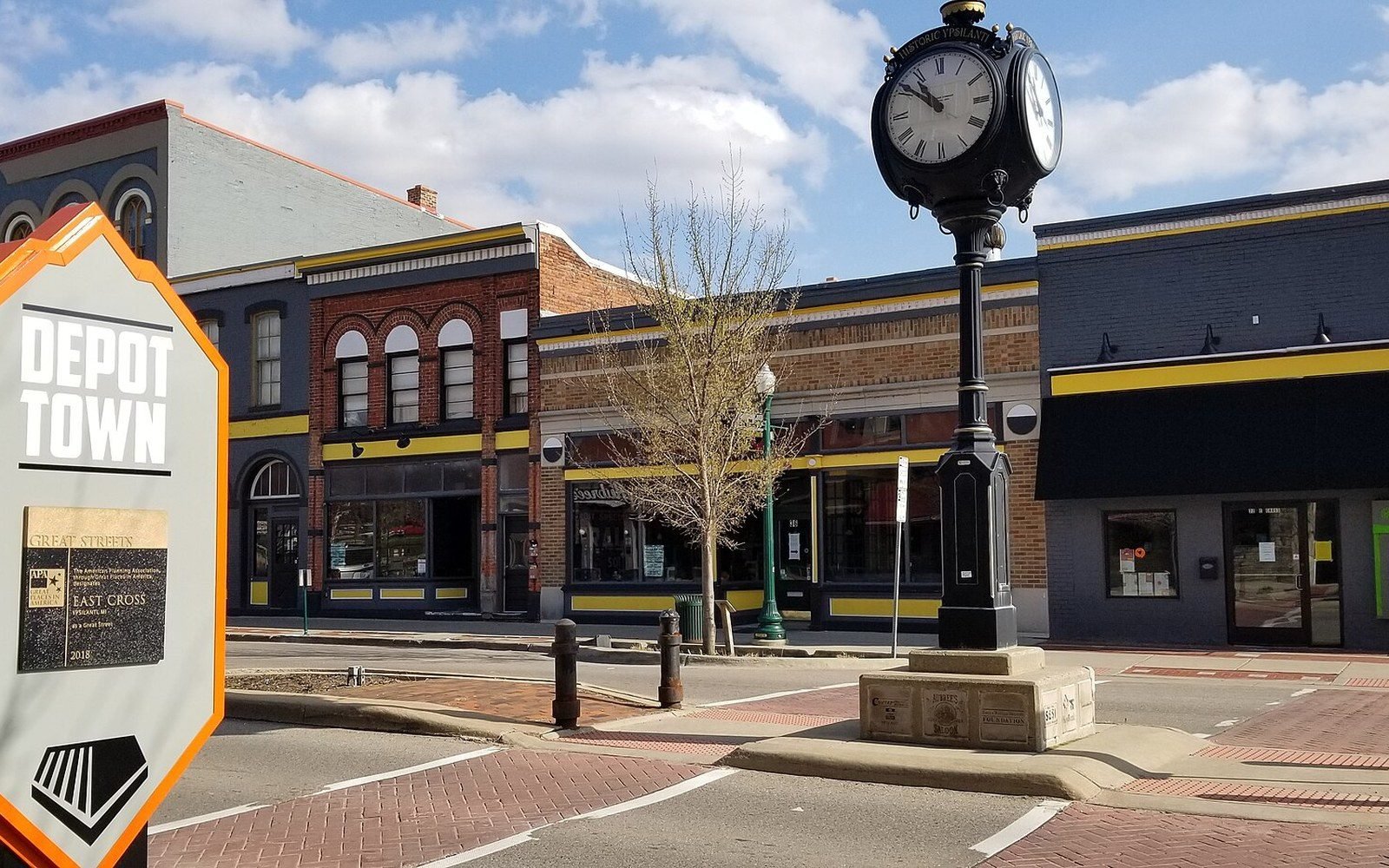
The depot itself sat close to the Huron River on the north side of town, and the district that grew up around it was never grand in the way that a city center aspires to grandeur. It was working and practical: warehouses, feed dealers, saloons, dry-goods merchants, and the kinds of enterprises that survive on throughput rather than reputation. The brick buildings that survive along East Cross Street and its surroundings weren't built to impress — they were built to last, because their owners expected decades of steady trade. That expectation was reasonable in 1870. It became less reasonable by 1930, and the district's long middle period, when the trains thinned and the freight found other roads, is what kept the buildings standing long enough to be rediscovered.
Freight Logic and the Shape of the Block
Understanding why the brick falls where it does requires thinking about freight, not tourism. A railroad depot in a nineteenth-century American town was primarily a freight operation. Passengers mattered, but the real money was in goods — grain, lumber, coal, manufactured hardware, dry goods arriving from the east, agricultural produce heading out. The depot served as the node, and the surrounding blocks filled with the businesses that needed to be within a wagon's reach of it.
That geometry is still legible in Depot Town. The buildings are oriented to the street, which was itself oriented to the rail corridor. Warehousing needed ground-floor access for loading. Retail needed proximity to the foot traffic that a station generated. The saloon and the hotel needed the traveler who had an hour to wait and a dollar to spend. What looks today like a pleasantly compressed little commercial district is actually the fossilized logic of nineteenth-century freight and passenger flow, preserved not through any act of civic vision but through the slower mercy of economic stagnation.
The Thompson Block, dating from the Civil War era, is among the older commercial survivals in this part of the city — a reminder that some of this construction preceded the most intense period of railroad commerce and was simply absorbed into it. But the majority of the district's brick fabric dates from the 1870s through the 1890s, when rail traffic through Ypsilanti was at something close to its peak. The corbelling on the upper cornices, the segmental arches over the windows, the recessed doorways — these are the architectural signatures of a moment when local merchants had enough confidence in the future to spend money on ornament. Read the brickwork and you're reading a business forecast.
How it came to be this way
- 1838Michigan Central Railroad arrives; depot economy begins
- 1870s–1890speak construction period for surviving brick commercial fabric
- Early 20th centuryinterurban era adds passenger traffic to the district
- Pre-WWIImajor electric interurban lines close across Michigan
- Mid-20th centuryholding pattern preserves shells; district avoids demolition
The River at the Edge of It
The Huron River isn't incidental to Depot Town's story — it's part of the reason the depot was where it was. Rivers had been the original infrastructure. Before rail, they set the terms of settlement, driving mills and providing transport corridors. Ypsilanti grew up at a ford and crossing point, and the industrial operations along the Huron — mills, small manufactories — were the economic foundation that made a rail connection worth having in the first place.
The Cross Street Bridge sits at a meaningful junction in this geography. On the east bank, the old brick of Depot Town; on the west bank, the broader commercial and civic city. The bridge was the hinge between the railroad economy and everything else, and crossing it on foot today you're retracing a movement that was once entirely transactional — mill workers, merchants, travelers arriving from the platform and heading into the town proper. The Huron, running beneath, had powered the industries that the railroad then connected to wider markets. The two infrastructure systems — water and rail — weren't rivals; they were sequential chapters in the same sentence.
The parks along the river — Riverside Park on the western bank, Frog Island in the bend — exist partly because those low-lying areas were never built over heavily in the first place. Industrial waterfronts tend toward the utilitarian, and when the industry departs, what remains is land close to water, which eventually becomes parkland by default. The leisure geography of present-day Ypsilanti is, in this sense, the residue of industrial geography.
But the bricks reward a moment of attention to what they actually remember.
The Interurban and the Freight It Couldn't Carry
Alongside the steam railroad, Depot Town also felt the presence of the interurban — the electric railway network that connected Ypsilanti to Ann Arbor, Detroit, and other communities across the region in the decades around the turn of the twentieth century. The interurban was primarily a passenger operation: it moved people efficiently and cheaply at a moment when the automobile had not yet reorganized everything. Its commercial effect on the depot district was real but different from the steam road's. It brought foot traffic — shoppers and visitors rather than freight — and for a period it sustained the retail layer of Depot Town even as pure freight economics began to shift.
The interurban died with the car. By the time the major electric lines had shut down — a process completed in Michigan well before the Second World War — the automobile had already begun reshuffling commercial activity toward arterial roads and, eventually, toward the highway-adjacent zones that would make older downtowns redundant. Depot Town sat slightly apart from this process, not prosperous enough to attract redevelopment and not derelict enough to be demolished wholesale. The result, visible in the fabric today, is a district that passed through the mid-twentieth century largely intact, absorbing uses — light warehousing, secondhand trade, marginal retail — that preserved the shells while neglecting the ornamentation.
What the Brick Remembers
There is a particular pleasure in reading Depot Town not as a destination but as a document. The buildings here record the confidence of the 1880s, the contraction of the early twentieth century, the long holding pattern of the postwar decades, and the more recent work of restoration and reoccupation. None of these phases erased the previous one entirely, which is what makes the district legible to anyone willing to look at a roofline rather than a menu.
The freight that once moved through here — the grain, the coal, the manufactured goods — is long gone, along with most of the rail infrastructure that carried it. The Michigan Central main line is still there in the landscape, still active as part of the broader rail network, but the depot economy it once sustained has been replaced by something lighter and more self-conscious. Restaurants and breweries now occupy spaces where merchants once took delivery from the platform. The logic is entirely different; the brick is the same.
That's not a lament. Cities recycle their fabric, and the survival of the Depot Town district — however altered — is preferable to its erasure. But the bricks reward a moment of attention to what they actually remember. They were laid by people who expected trade to continue, who built for freight and function rather than for an audience. The fact that they now constitute a kind of civic amenity, a pleasing irregularity in the texture of a mid-sized Michigan city, would have struck their builders as a strange and possibly insufficient reason to put up a building. It is, however, reason enough to keep one standing.
Keep reading